Attention in the pits: We interrupt the usual programming order to bring you this special, midseason-1967 installment of Drag Rags due to two historic happenings three months apart: the grandest opening imaginable for the original Supertrack—constructed for a staggering cost of $750,000—closely followed by the inaugural Manufacturers Meet. The fact that the same young venue presented both the August and November events hinted at Orange County International Raceway's singular impact upon a young American motorsport.
OCIR's three-story, octagon-shaped timing tower with its dimly-lit nightclub of a top floor was instantly iconic at a time when race tracks' prevailing architectural style is best described as midcentury plywood. Full marching bands stomped the length of this landscaped drag strip. A stunt pilot performed aerobatics before landing on the racing surface, taxiing to cheers. Clean-cut ushers oversaw reserved, numbered seats with redwood backrests.
An army of employees on and off the track was clothed in matching white pants and blue Hang 10 shirts. The uniforms' embroidered Indy-car logo represented the big-time road racing that was expected to top the marquee and pay the big bills, while twice-weekly drag races kept some cash flowing between envisioned open-wheel, motorcycle and sports-car extravaganzas that never materialized (nor did the rented shop buildings that founder Mike Jones expected to ensure steady cashflow).
After having worked as a journalist covering drag racing for more than 50 years I stepped away in 2018. Despite my not having personally attended an event during the ensuing years I’ve paid close attention to what’s taken place both on and off the track. I’ve also maintained my personal relationships with numerous competitors, team owners, journalists and track owners. I’m mentioning those points just to assure our readers that I’m not firing blindly with this guest editorial, nor do I have any axe to grind with NHRA or anyone else in the sport. As I have said – and written – numerous times, I want only the best for NHRA and everyone else involved in the endeavor. Put more succinctly, a healthy and vibrant NHRA is beneficial to everyone involved.
The success of the SCAG PRO Superstar Shootout in Bradenton, Fl. should have been a wake-up call for the National Hot Rod Association’s management team, but to date, there’s been no public indication that it made an impact on them. I’m not finding fault with that, but they can’t wait too long before publicly reacting.
It's one event, but right out of the gate, the inaugural PRO Superstar Shootout landed the most difficult jump for any fledgling program. The event produced an entertainment home run.
It had close racing, record-setting times, and plenty of fans on hand to witness it. The event was much like watching Metallica play at the Whiskey-A-Go-Go.
I've been a professional journalist for 37 years. The first thing the journalistic legends of this sport taught me was to remain objective. It's not personal, it's a job; an assignment. When the readers peruse your copy of said assignment, they shouldn't be able to tell on which side of the fence you stand.
From a peak of four independent national weeklies publishing simultaneously from southern California the previous year, this 1967 season opened with just two survivors: Doris Herbert's dominant Drag News, the long-established "Drag Racer's Bible" (est. 1955), and sophomore challenger Drag Digest, now tagging itself as the "Drag Racer's New Testament."
It wasn't much of a race, in hindsight. After briefly increasing ad pages in the wake of mid-1966's back-to-back Drag Sport Illustrated shutdown and Drag World sale to AHRA, the promising newcomer increasingly showed signs of desperation as this season unfolded. Circulation claims grew wilder, less believable. Front-page headlines grew larger, more sensational. Subscriptions were offered "on credit." Founding publisher J.L. Sutton moved down the masthead one spot, signaling some sort of bailout by the unknown new guy.
Most telling was Drag Digest's shrinking package size: down from an industry-high 64 standard-sized pages in 1966 to as few as six oversized pages now, padded with large photos. Whereas Doris Herbert had built up a network of reliable contributors and columnists across North America, plus year-'round advertisers, a rainy SoCal weekend was disastrous for a fledgling competitor relying almost entirely on race reports, pictures, and results-based advertising from that one region. When it rained, it poured—empty space. The last issues in our archive carry June 1967 cover dates.
I met Don Schumacher 57 years ago and honestly, wasn’t impressed. I thought him a punk of the first order – and I wasn’t alone. At the time Chicago was, in many respects, the center of Funny Car match racing, and Schumacher wasn’t immediately “accepted” by the touring stars of the day. His brash personality, barely hidden arrogance and frequent references to his family’s money didn’t endear him to his peers, who were mostly up-by-their-bootstraps racers simply trying to survive in an ever-evolving world of drag racing.
At about the same time I met another Funny Car driver – Paula Murphy. The differences in their personalities were too numerous to elucidate, but where Don might run roughshod over people, Paula met them with a ready smile and, more often than not, a salient response for any guy foolish enough to try and play the chauvinist card.
Ironically enough, it was Schumacher who largely changed over the years, becoming a championship driver after coming to the realization that his antics weren’t winning him trophies – or friends. Paula never changed because she was a fully-formed individual 50-plus years ago and remained the same until her death at 95. Don, however, was cut down by cancer in his 79th year.
On August 13, it’ll be 29 years since Timothy Lee “Tim” Richmond succumbed to the devastating effects of the AIDS virus. He was 34.
The late Raymond Beadle, with whom Tim enjoyed his first real success on the NASCAR tour, was himself one of the “cool kids” in a very cool era but even he was overshadowed by Richmond’s larger than life persona. Tim was a modern day Errol Flynn, the movie swashbuckler from the 1940s. You may have seen him on American Movie Classics. If not, Google him because that was Tim Richmond.
There are times when I miss being a 13 year old kid with an insatiable drag racing appetite. Sometimes we get lost in our adult perceptions using the past as a barometer for the future.
There are times when youthful enthusiasm is a better approach than age and treachery. Thanks to a ten year old girl whom I never met, only read about—my opinion changed.
If you haven’t read Susan Wade’s excellent article about Olivia Byer’s enthusiasm to join her mother, Coca-Cola exec Sharon Byers in the unveiling of the Mello Yello sponsorship for the 2013 NHRA Championship Drag Racing Season, you should.
Before I hit the first keystroke, I was seeking to find a way to criticize yet another brand as series sponsor.
I wasn’t sold on the Mello-Yello series assignment. In fact, I was dead set against it. Many of our readers were too as evidenced by an informal Facebook poll.
This golden age of drag-racing publishing peaked at around the same time that the tabloid Drag Sport Illustrated was forced out of business: midsummer 1966. Three independent L.A. weeklies had been competing nationally, though Drag News consistently buried its younger rivals in ad revenue and package size. By the end of August, Drag Sport Illustrated had inexplicably vanished, and Drag World was being neutered into a house organ by a third owner, the American Hot Rod Association. Before Drag Rags turns the calendar to the 1967 season (coming next time), we'll take this opportunity to commemorate the feisty drag rag whose independence ended with 1966.
Until five years ago, neither Drag Sport founder Phil Bellomy nor his final editor, Forrest Bond, was ever interviewed about how IRS agents interrupted production of an August 6, 1966, edition that never showed up in baffled subscribers' mailboxes. I spoke to each on behalf of now-defunct Drag Racer magazine, which published the original version of this article in 2008. (Alas, Forrest Bond's first interview about DSI proved to be his last: The publishing veteran has since passed away.)
The Golden Age of Drag Racing Publishing that our series celebrates was not without its casualties. This second half of 1966 dealt deadly, back-to-back blows to fully two-thirds of the independent, national weeklies featured in recent installments. In July, Drag Sport Illustrated, the longest-running competitor to Drag News, was shut down by the U.S. Treasury Department after nearly three-and-a-half years of weekly publishing. No less shocking came Drag World's August sale to Jim Tice, who moved headquarters to AHRA's Kansas City office and hired all-new staff. Only the logo and layout design remained the same. In one month's time, thousands of readers lost a combined 100 issues a year of independent reporting and opinion columns.
Had these two dead tabloids managed to hang on a little longer, there might've briefly been six independent drag weeklies coming out of L.A. simultanously in mid-1966! One weekend after Drag Sport disappeared, something called Drag Digest was handed out free at SoCal strips, bravely promising better coverage of Western events than Drag News had been providing since 1955. Doris Herbert, the powerful Drag News publisher (since 1959), retaliated with Drag West, a separate weekly devoted to five Western states. Both battling tabloids wholeheartedly embraced Funny Cars, whereas all of their newsprint predecessors favored traditional open-wheel favorites: competition coupes, modified roadsters, altereds, and especially dragsters. Drag News additionally spotlighted the gas coupes and sedans responsible for generating a disproportionately-large number of advertising dollars during the "Gasser Wars" fought primarily on its pages.





 After having worked as a journalist covering drag racing for more than 50 years I stepped away in 2018. Despite my not having personally attended an event during the ensuing years I’ve paid close attention to what’s taken place both on and off the track. I’ve also maintained my personal relationships with numerous competitors, team owners, journalists and track owners. I’m mentioning those points just to assure our readers that I’m not firing blindly with this guest editorial, nor do I have any axe to grind with NHRA or anyone else in the sport. As I have said – and written – numerous times, I want only the best for NHRA and everyone else involved in the endeavor. Put more succinctly, a healthy and vibrant NHRA is beneficial to everyone involved.
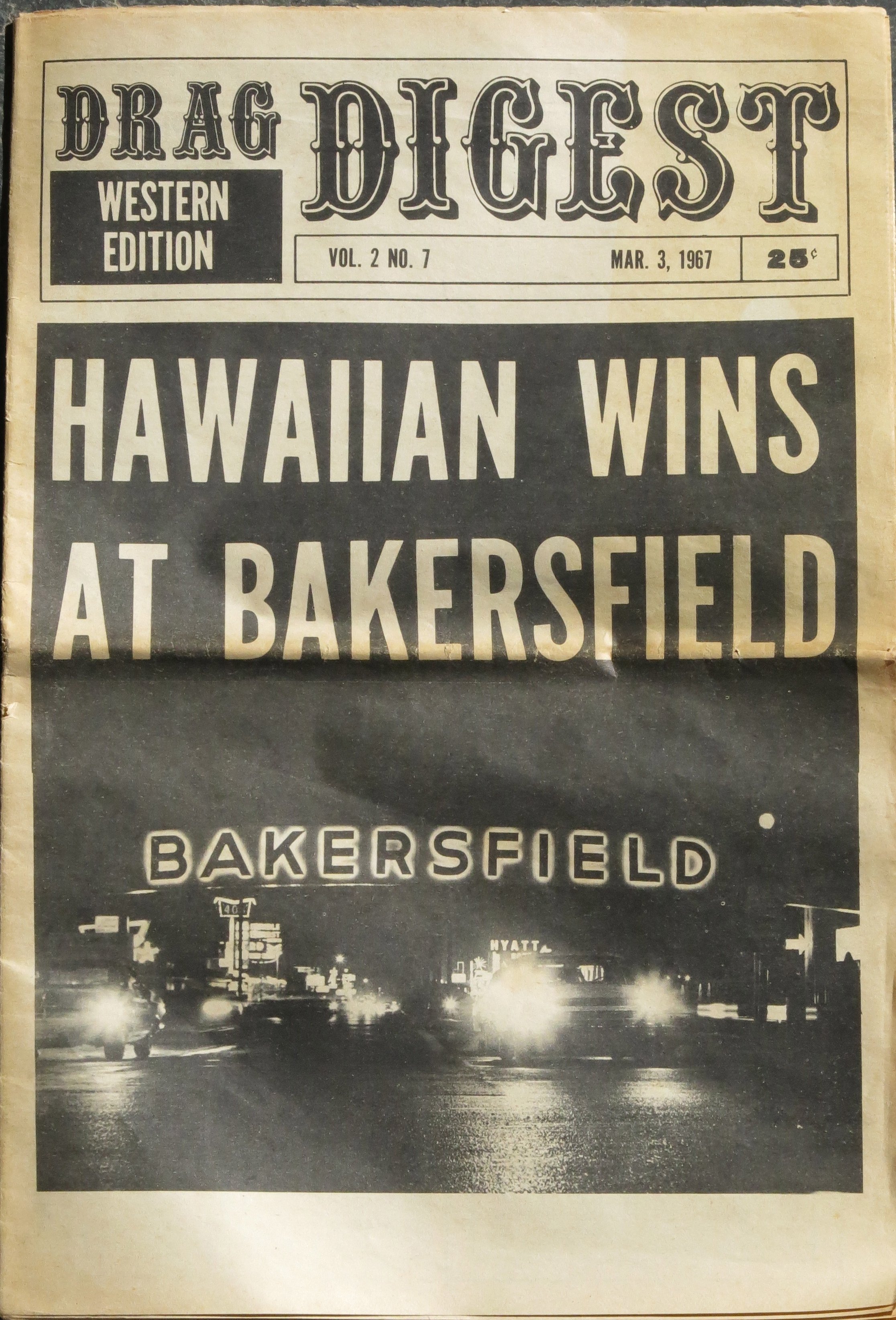 From a peak of four independent national weeklies publishing simultaneously from southern California the previous year, this 1967 season opened with just two survivors: Doris Herbert's dominant Drag News, the long-established "Drag Racer's Bible" (est. 1955), and sophomore challenger Drag Digest, now tagging itself as the "Drag Racer's New Testament."